Pakistan is stepping into a new era of digital education as the government of Khyber Pakhtunkhwa has officially approved the country’s first public sector virtual school system powered by Artificial Intelligence (AI). This major initiative aims to transform traditional education by making learning more accessible, modern, and flexible for students across the province and beyond.
The project has been approved under the leadership of Sohail Afridi, who chaired a high-level meeting of the Elementary and Secondary Education Department. Along with this, the government has also given in-principle approval to establish an AI Education Authority to manage and regulate the new digital education system.
A Major Step Toward Digital Education in Pakistan
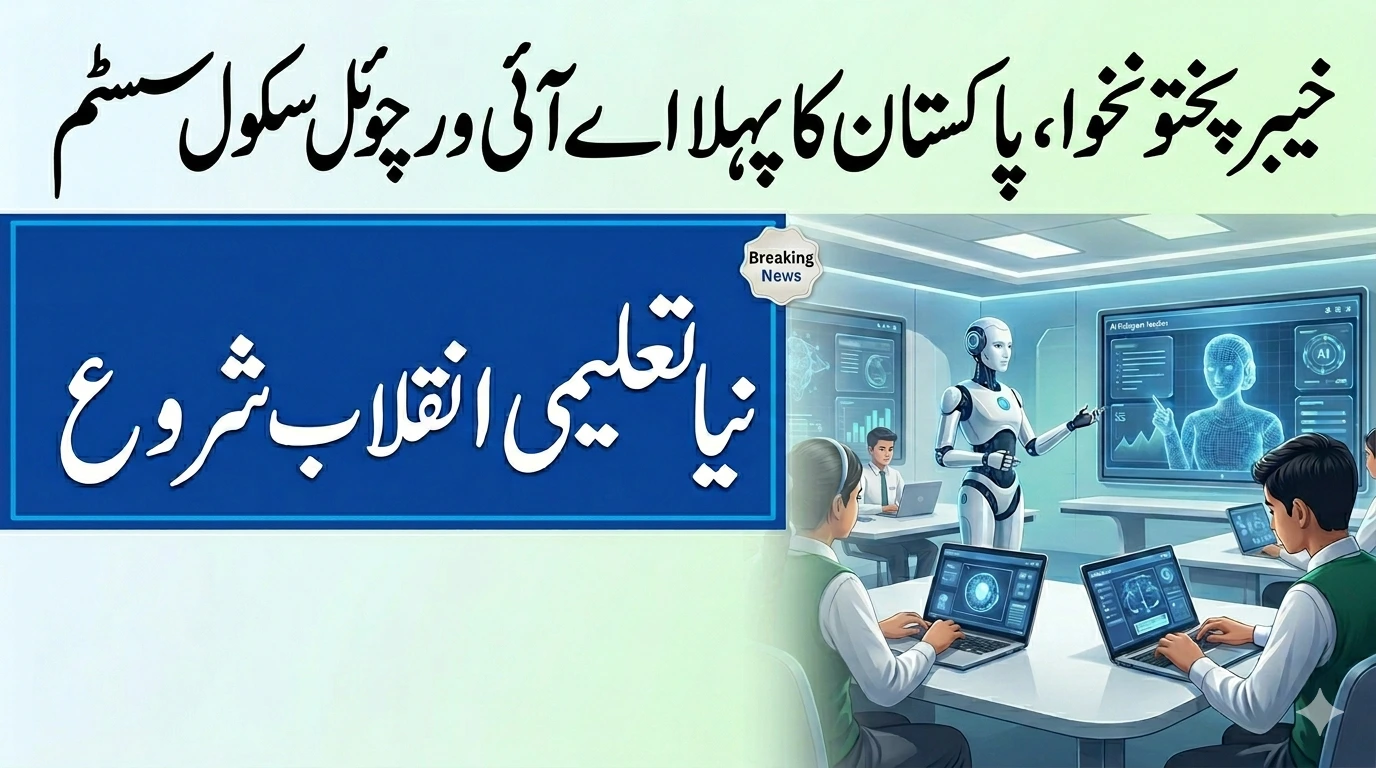
The newly approved virtual school system is designed to modernize education by integrating AI-based teaching tools. Under this system, students will be able to attend online classes, access recorded lectures, and learn through an AI-powered teacher.
Officials confirmed that the system is already in the pilot phase. Around 46 government schools have been shifted to an online learning model, including:
-
33 schools from settled districts
-
13 schools from merged districts
The government also plans to expand this initiative by converting 175 additional schools into virtual institutions in the coming phase.
AI Teacher Available 24/7 for Students
One of the most innovative features of this project is the AI teacher system, which will be available 24 hours a day. This AI-based teaching assistant will support students in multiple languages, including:
-
Urdu
-
English
-
Pashto
Students will be able to study key subjects such as:
-
English
-
Mathematics
-
Physics
-
Chemistry
-
Biology
This personalized learning system is expected to help students learn at their own pace while improving understanding of complex topics.
Central Digital Teaching Studio
To support this initiative, the government is also establishing a central digital teaching studio. This studio will be equipped with modern tools for:
-
Live interactive classes
-
High-quality lecture recordings
-
Digital content creation
Teachers will be able to deliver lessons online, making education more accessible for students in remote and underdeveloped areas.
Equal Status for Virtual School Students
A major policy decision under this project is that students enrolled in virtual schools will be treated as regular students. This includes:
-
Students in remote areas
-
Out-of-school children
-
Overseas Pakistanis
This step ensures equal educational opportunities for all learners, regardless of location or circumstances.
Cost and Investment Details
The total cost of the project has been approved at Rs153.8 million, with Rs44.85 million allocated specifically for the establishment of a tele-education hub.
Officials have described the project as a “game-changer” for the education sector, especially for students living in remote and underserved regions.
Why This Initiative Matters
This AI-powered education system is expected to bring several long-term benefits:
-
Improved access to quality education
-
Reduced dependency on physical classrooms
-
Support for students in remote areas
-
Personalized learning through AI
-
Reduced workload for teachers
-
Better digital literacy in students
Experts believe this initiative could become a model for other provinces in Pakistan if successfully implemented.
Future of Education in Pakistan
With rapid advancements in technology, Pakistan’s education system is gradually shifting toward digital transformation. The introduction of AI-based virtual schools is a significant step in aligning the country with global education trends.
If implemented effectively, this system can bridge the educational gap and ensure that every child, regardless of background, has access to quality learning opportunities.
FAQs
1. What is the AI virtual school system in Khyber Pakhtunkhwa?
It is a government-approved digital education system that uses AI technology to deliver online classes and personalized learning to students.
2. Which subjects will the AI teacher cover?
The AI system will teach English, Mathematics, Physics, Chemistry, and Biology.
3. Who can enroll in virtual schools?
Students from remote areas, out-of-school children, and overseas Pakistanis will be eligible, and they will be treated as regular students.
4. Is the project already active?
Yes, it is currently in the pilot phase with 46 government schools already converted into virtual learning systems.
5. Will the AI system support multiple languages?
Yes, it will be available in Urdu, English, and Pashto.