The education system in Punjab is undergoing a major structural transformation through the Punjab Education, Curriculum, Training and Assessment Authority (PECTAA). This initiative represents a shift toward centralized, standardized, and technology-based evaluation. The recent Grade 8 board examinations conducted under this system have become a reference point for how large-scale student assessment can be managed more efficiently. The success of these exams has encouraged policymakers to consider expanding the system further, including its possible extension to private schools.
Read Also: Pectaa Results 2026 By Roll Number & Name
PECTAA Examination System Overview in Punjab
PECTAA was established to improve the quality and consistency of education assessment across Punjab. The authority focuses on curriculum alignment, teacher training, and standardized examinations. One of the key problems in traditional systems has been inconsistency in marking and delayed results, which has affected student confidence and academic planning. PECTAA aims to address these issues through a centralized structure that ensures uniform standards across the province.
The system also represents an attempt to modernize education governance. Instead of fragmented evaluation methods across different schools and boards, PECTAA introduces a unified academic framework. This approach is designed to reduce inequality and improve transparency in how students are assessed.
Read Also: PECTAA Announces Major Update: Class 5 & 8 Board Exams for All Schools in 2027
Grade 8 Board Examination Milestone
A major achievement of PECTAA has been the successful execution of Grade 8 board examinations involving nearly one million students. Managing such a large number of candidates required strong administrative coordination and digital infrastructure support. The scale of this examination makes it one of the largest standardized school-level assessments conducted in the province.
The timely completion of results within approximately one and a half months was also a significant achievement. Traditionally, examination results take much longer due to manual processing. The improved timeline demonstrates how system automation can reduce administrative delays and improve efficiency.
Read Also: PECTAA Grade 8 Registration 2026–27 via Item Bank System IBS
Introduction of Digital On-Screen Marking System
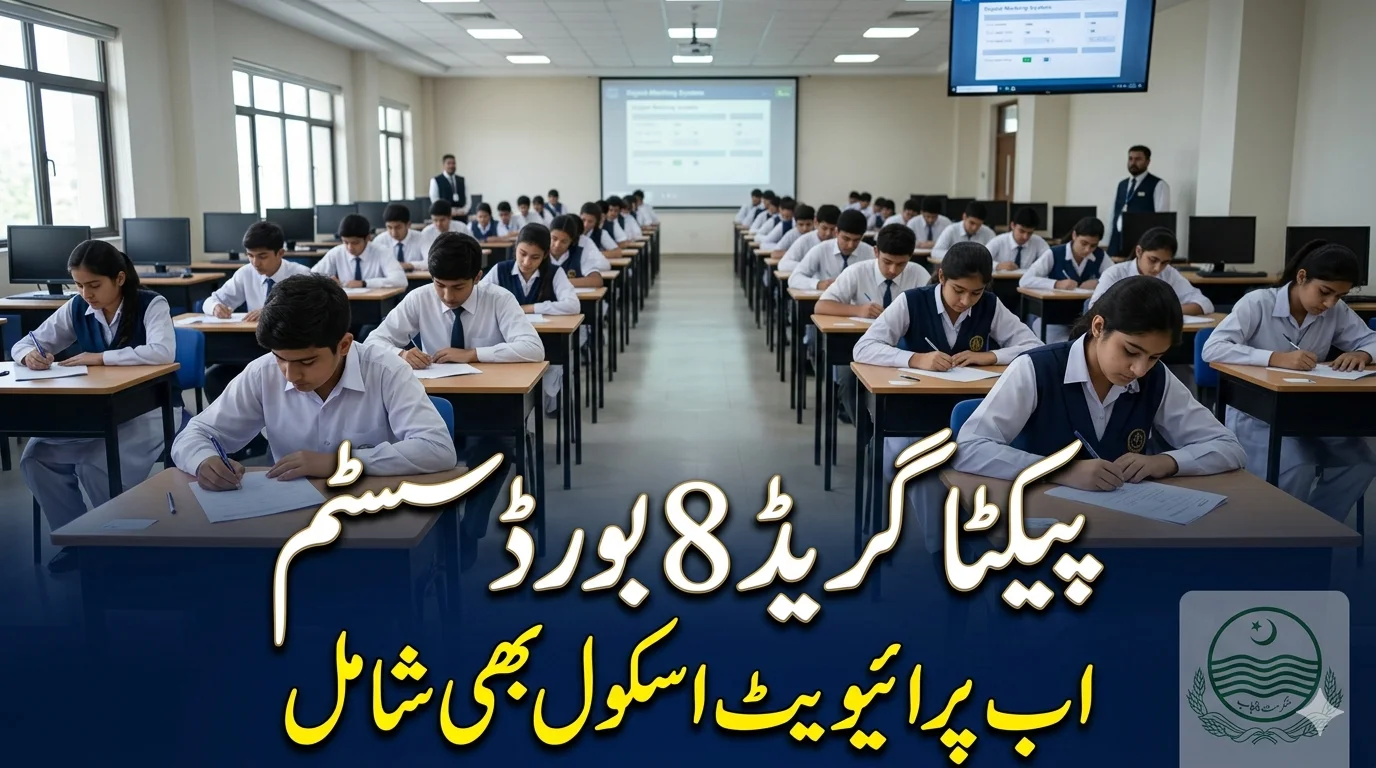
The introduction of the on-screen marking system is one of the most important reforms within PECTAA. Instead of physical answer sheets being manually checked and passed between examiners, scripts are scanned and evaluated digitally on computer screens. This reduces human error, prevents loss of papers, and improves consistency in grading.
The system allows multiple examiners to review scripts under controlled conditions. It also enables centralized monitoring, which helps maintain accountability during the marking process. According to official statements, the evaluation process was completed without major errors, highlighting the reliability of the digital system.
Read Also: Punjab Grade 8 Result 2026 Announced: 88% Pass Rate in First AI-Based Exam
Speed and Efficiency of Result Processing
One of the most visible benefits of the digital system is the speed of result processing. The Grade 8 results were compiled and announced within a relatively short period, which is a significant improvement compared to traditional systems.
This efficiency is achieved through automation. Once marking is completed, data is processed electronically, eliminating the need for manual tabulation. This reduces workload and allows authorities to focus on quality control rather than repetitive administrative tasks.
Read Also: PECTAA Smart Syllabus Class 11 2026 All Subjects [PDF Download]
Transparency Improvements in Examination System
Transparency has always been a concern in examination systems where manual processes dominate. The digital marking system introduced by PECTAA reduces the risk of inconsistencies and manipulation. Each script is digitally tracked, and every marking action is recorded.
This creates a traceable system where errors can be identified and corrected more easily. It also increases trust among students and parents, as the evaluation process becomes more structured and verifiable.
Punjab Government’s Plan for Private School Inclusion
The Punjab government is now considering expanding the PECTAA examination framework to private schools. This step is aimed at creating a unified education assessment system across both public and private sectors.
The objective is to ensure that all students are evaluated using the same standards. However, this proposal may also face challenges, as private schools often operate under different academic models. The success of this expansion will depend on policy design and stakeholder cooperation.
Standardization of Education Across Punjab
A standardized examination system ensures that students across different regions and institutions are assessed fairly. This reduces disparities in grading systems and improves the credibility of academic results.
Standardization also helps universities and employers make better decisions based on reliable academic performance indicators. However, it must be implemented carefully to avoid placing undue pressure on under-resourced schools.
Student Performance and Academic Impact
The introduction of centralized examinations has a direct impact on student learning behavior. Students tend to prepare more systematically when they know that assessment standards are uniform and strictly monitored.
However, the transition period may also create adjustment challenges. Students and teachers need time to adapt to new formats and expectations, especially when digital evaluation replaces traditional patterns.
Teacher Training and System Adaptation
Teachers play a critical role in the success of the PECTAA system. Digital marking and standardized assessment require proper training and technical understanding. Without adequate support, implementation can become inconsistent.
Training programs are necessary to ensure that educators are comfortable with new systems. This includes understanding digital tools, marking procedures, and evaluation standards.
Administrative Benefits of Digital Examination System
From an administrative perspective, the digital system reduces workload and operational costs. It minimizes the need for physical storage of exam papers and reduces logistical challenges related to paper distribution.
It also improves efficiency in record management. Data is stored digitally, making it easier to retrieve and analyze student performance statistics.
Challenges in Expanding Digital Exam System
Despite its advantages, the system faces challenges in expansion. Infrastructure limitations, particularly in rural areas, can affect implementation. Reliable internet access and digital literacy are essential for smooth operation.
Without addressing these gaps, the system may face uneven performance across different regions.
Role of Education Experts in Reform Validation
Education experts have generally supported the move toward digital assessment systems. They recognize improvements in transparency and efficiency while also emphasizing the need for continuous monitoring.
Their input is important in refining the system and ensuring that it meets academic standards without compromising fairness.
Comparison Between Traditional and Digital Exams
Traditional examination systems rely heavily on manual processes, while digital systems introduce automation and structured evaluation.
| Feature | Traditional System | Digital PECTAA System |
|---|---|---|
| Marking Speed | Slow | Fast |
| Error Rate | Higher | Lower |
| Transparency | Limited | High |
| Efficiency | Moderate | High |
Future Expansion of Grade 8 Examination System
The success of Grade 8 examinations is expected to lead to further expansion in future academic years. The government has indicated plans to broaden the scope of standardized assessments across additional grades.
This gradual expansion allows the system to be tested and improved over time before full-scale implementation.
Technology Integration in Education Assessment
The education sector in Punjab is increasingly integrating technology into assessment and administration. Digital marking systems are just one part of a larger transformation that may include artificial intelligence and data analytics in the future.
Such integration can improve decision-making and help identify learning gaps more effectively.
Debate on Private School Integration
The inclusion of private schools in the PECTAA system has generated debate. Supporters argue it will create fairness and consistency, while critics fear it may limit flexibility in private education.
Balancing these perspectives will be essential for successful implementation.
Improvement in Learning Assessment Quality
Standardized digital assessment improves the quality of evaluation by reducing subjectivity. Students are assessed based on uniform criteria, which enhances academic fairness.
This also helps institutions maintain higher academic standards across the board.
Reliability of On-Screen Marking System
The on-screen marking system has shown strong performance during its initial implementation. Officials reported no significant errors during evaluation, indicating a stable and reliable system.
However, continued monitoring is necessary to ensure long-term sustainability and accuracy.
Impact on Pakistan’s Education Framework
If successfully expanded, the PECTAA model could influence broader education reforms across Pakistan. Other provinces may adopt similar systems to improve transparency and efficiency in their examination processes.
This could lead to a more unified national education assessment structure.
Future Outlook of Punjab Education Reform
Punjab’s education system is moving toward a more digital and standardized future. The expansion of PECTAA reflects a long-term strategy to modernize academic evaluation.
While challenges remain, the direction of reform indicates a shift toward efficiency, transparency, and technology-driven education governance.
Conclusion
The PECTAA examination system represents a significant shift in Punjab’s education landscape. The successful execution of Grade 8 board examinations and the introduction of digital on-screen marking demonstrate the potential of technology in improving academic assessment. The proposed expansion to private schools could further strengthen standardization across the province. However, the success of this reform depends on infrastructure readiness, teacher training, and careful policy implementation. If managed effectively, this system could serve as a model for modern education assessment in Pakistan.
FAQs
1. What is PECTAA in Punjab?
PECTAA is an authority responsible for curriculum development, teacher training, and standardized student assessment in Punjab.
2. How many students appeared in Grade 8 exams under PECTAA?
Nearly one million students participated in the Grade 8 board examinations.
3. What is on-screen marking?
It is a digital system where exam papers are evaluated on computers instead of being checked manually.
4. Will private schools be included in PECTAA exams?
The government is considering expanding the system to include private schools for uniform assessment.
5. Why is PECTAA considered important?
It improves transparency, reduces errors, speeds up results, and standardizes education assessment across Punjab.